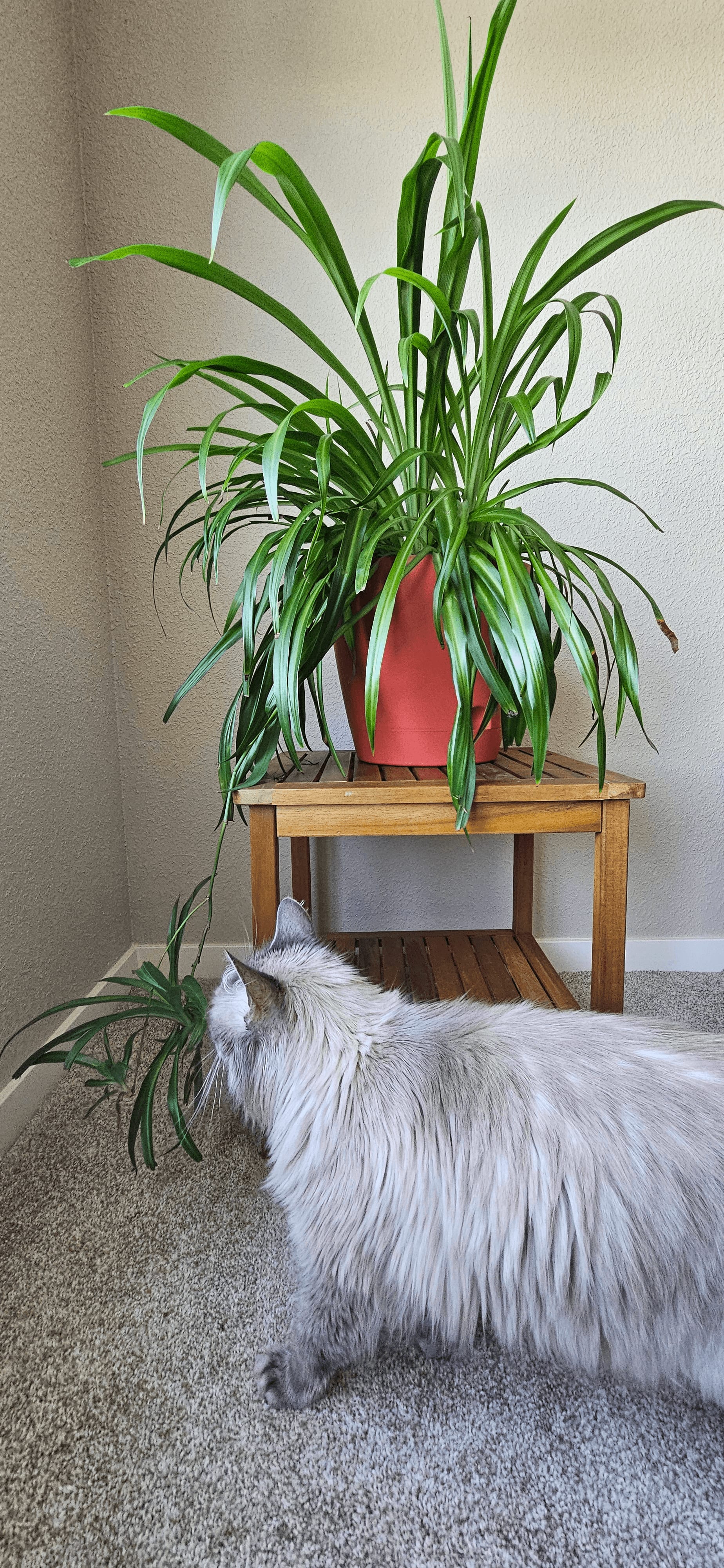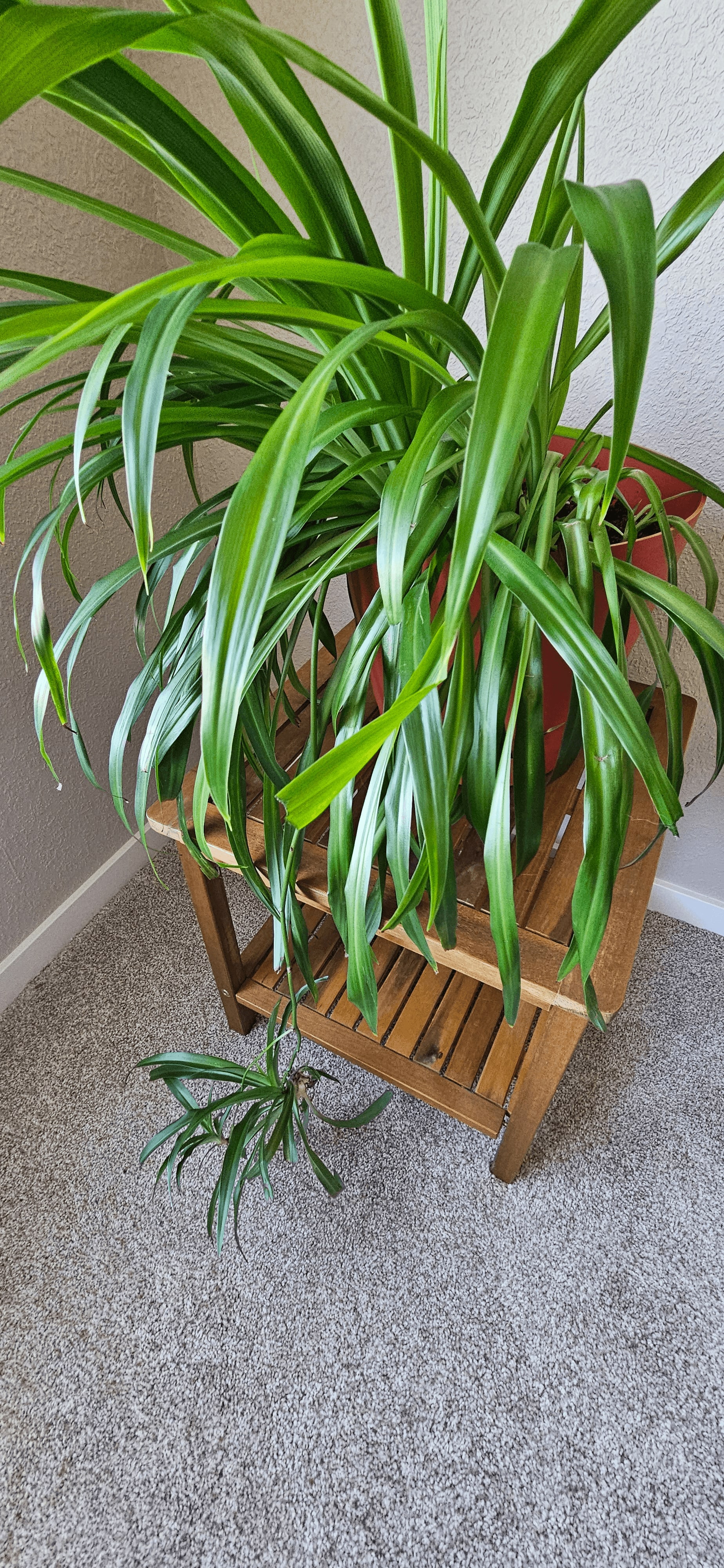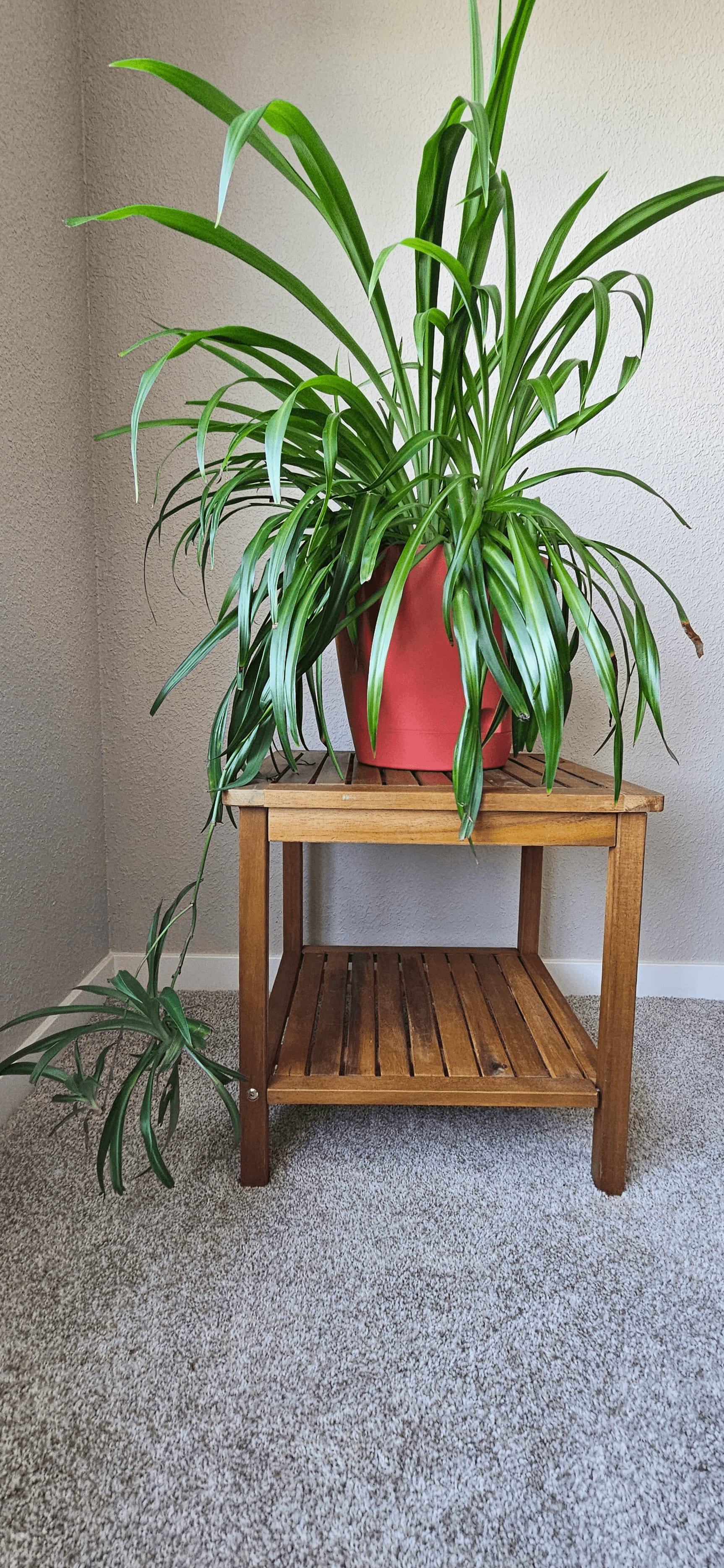
Chlorophytum comosum grows to about 60 cm (24 in) tall, although as a hanging plant it can descend many feet. It has fleshy, tuberous roots, each about 5–10 cm (2–4 in) long. The long narrow leaves reach a length of 20–45 cm (8–18 in) and are around 6–25 millimetres (0.2–1.0 in) wide.
Flowers are produced in a long, branched inflorescence, which can reach a length of up to 75 cm (30 in) and eventually bends downward to meet the earth. Flowers initially occur in clusters of 1–6 at intervals along the stem (scape) of the inflorescence. Each cluster is at the base of a bract, which ranges from 2–8 cm (0.8–3.1 in) in length, becoming smaller toward the end of the inflorescence. Most of the flowers that are produced initially die off, so that relatively, the inflorescences are sparsely flowered.
Individual flowers are greenish-white, borne on stalks (pedicels) some 4–8 mm (0.2–0.3 in) long. Each flower has six triply veined tepals that are 6–9 mm (0.2–0.4 in) long and slightly hooded or boat-shaped at their tips. The stamens consist of a pollen-producing anther about 3.5 mm (0.1 in) long with a filament of similar length or slightly longer. The central style is 3–8 mm (0.1–0.3 in) long. Seeds are produced in a capsule, 3–8 mm (0.1–0.3 in) long, on stalks (pedicels) that lengthen to up to 12 mm (0.5 in).
The inflorescences carry not only flowers but also vegetative plantlets at the tips of their branches, which eventually droop and touch the soil, developing adventitious roots. The stems (scapes) of the inflorescence are called "stolons" in some sources, but this term is more correctly used for stems that do not bear flowers and have roots at the nodes.
![Image of the [object Object] plant](https://res.cloudinary.com/dy8loseyh/image/upload/f_auto,q_auto/v1721648641/spider_plant_2e781e8114.png)
Photo credit to Lauren Keller
Chlorophytum Comosum
Asparagaceae Family
Also known as Spider Plant
Chlorophytum comosum, usually called spider plant or common spider plant due to its spider-like look, also known as spider ivy, airplane plant, ribbon plant (a name it shares with Dracaena sanderiana), and hen and chickens, is a species of evergreen perennial flowering plant of the family Asparagaceae. It is native to tropical and Southern Africa but has become naturalized in other parts of the world, including Western Australia and Bangladesh. Chlorophytum comosum is easy to grow as a houseplant because of its resilience, but it can be sensitive to the fluoride in tap water, which commonly gives it "burnt tips". Variegated forms are the most popular.
This plant is a
perennial
Dry
Soaked
Spider plants like moist soil. Make sure the soil is barely dry between waterings and don't over water. The plant shouldn't be in standing or seeping water.
Shade
Direct
The plants like partial sun exposure. A few feet away from a north, east, or west facing window will be totally fine.
Starved
Full
These guys like to be fed around once a month during the growing season. Don't feed during the colder months of the year.